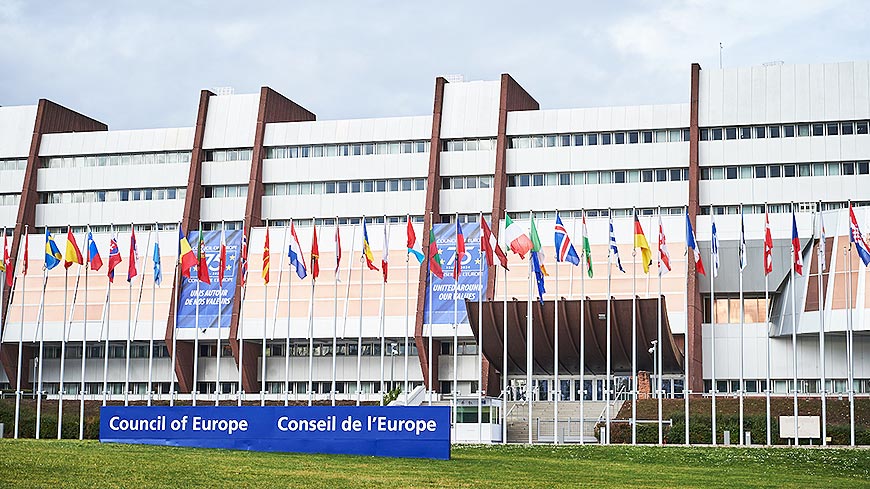
I am looking forward to beginning work in the Council of Europe’s new Expert Committee on Media Regulators in a Platform-Based Environment. There are three reasons I think this is important.
First, with the other independent expert members, I hope we can ensure that we can help base the committee’s work on research. Policy is necessarily political, but it is also about evidence, and here independent experts can help.
Second, media regulators are typically set up for a mass media environment, but today have to do their important work in a platform-dominated environment. I hope we in the committee can offer ideas for how to evolve regulators’ role, remit, and resources to the media environment we have, rather than the one we had.
Third, the Expert Committee’s work is under the aegis of the CoE Division in charge for work on freedom of expression and media freedom. This is particularly important in a time of democratic backsliding and attacks on fundamental rights, as media regulators are unfortunately often one of the independent institutions that would-be autocrats seek to subvert and instrumentalize in pursuit of media capture and worse.
I hope our work in the committee can consider both the different kinds of good that media regulators can do, help ensure they have tools for the present and the future, not just the past, and consider how to limit the harm they can be used to do.
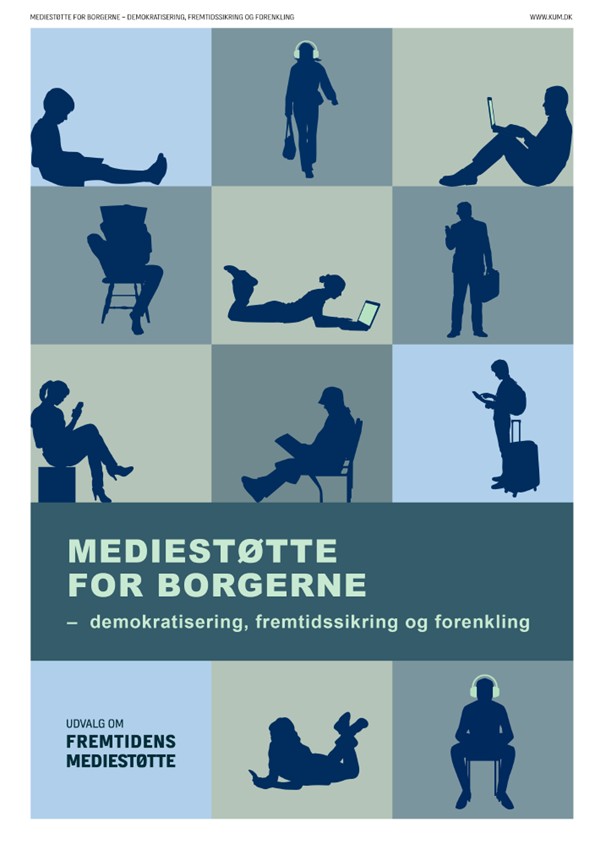
’Mediestøtte for borgerne – demokratisering, fremtidssikring, og forenkling’ (Media subsidies for citizens – democratization, futureproofing, and simplification). The recommendations from the Commission on the Future of Media Subsidies that I have chaired for the Danish government is now out.
In our report, we have worked to develop a set of principles to undergird and practical solutions to deliver direct subsidies to news media in Denmark in a way that will modernize the current system and ensure it can work in an effective, legitimate, and transparent manner going forward.
For those interested in having a look at the full report in Danish, it is available here.
And stay tuned for more from me in English in the coming weeks, summarizing key parts of the approach we outline, as I hope our work will be useful elsewhere
It was a real privilege to chair the commission over the last year, and to work with the members and the civil servants who supported us.
How do people think different sectors’ use of generative AI will change their experience of interacting with them?
That’s one of the question we fielded in a new survey, and one of the three key findings from my perspective – looking across the six countries covered, there are more optimists than pessimists for e.g. science and healthcare, and for search engines and social media, but more pessimists than optimists for news media, the national government, and – especially – politicians and political parties.
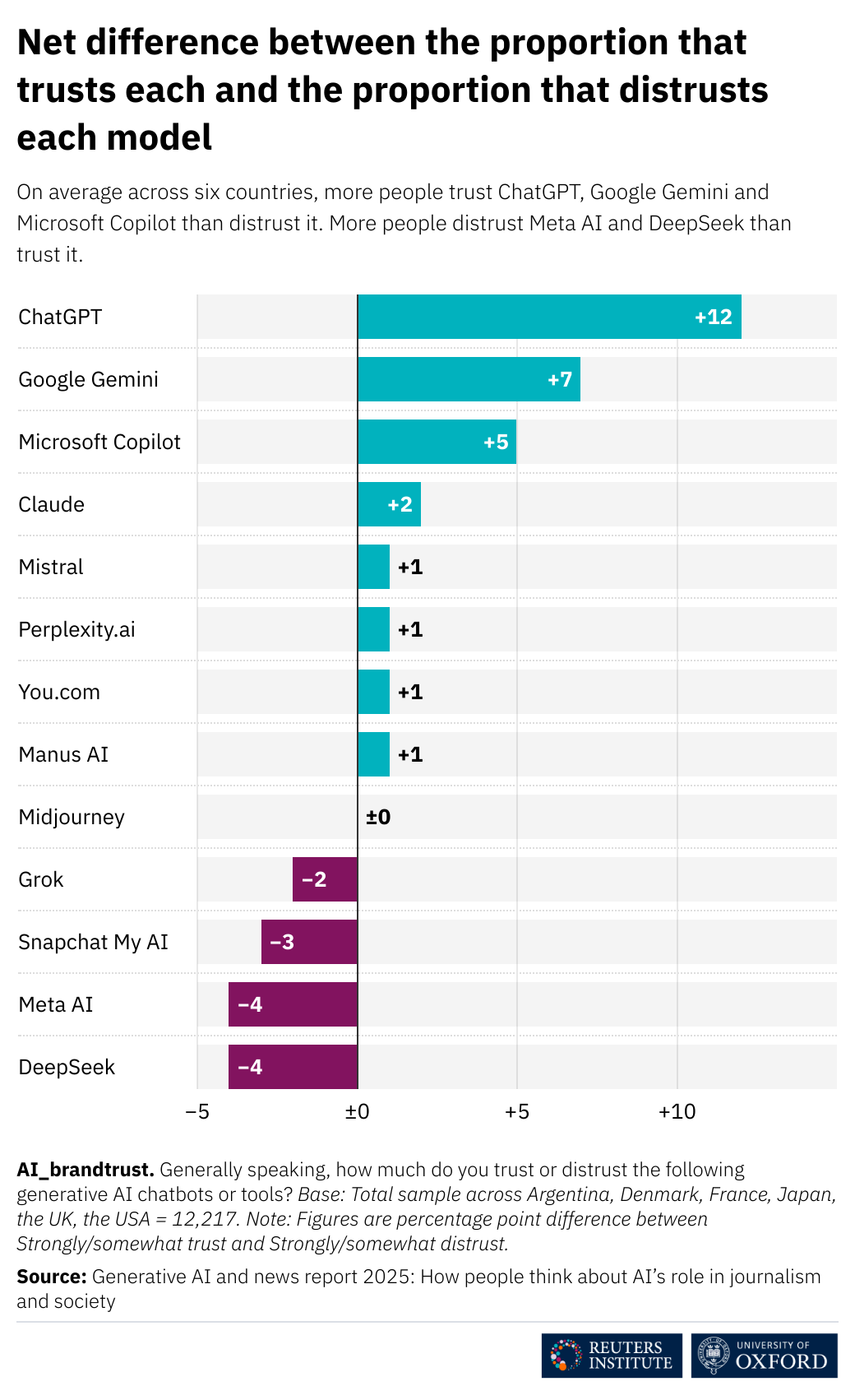
Elsewhere in the survey, we ask whether people trust different generative AI offers – the picture is very differentiated, with net positive trust scores for e.g. ChatGPT, Google Gemini, and Microsoft Copilot, but negatives for those that are seen as part of various social media companies.
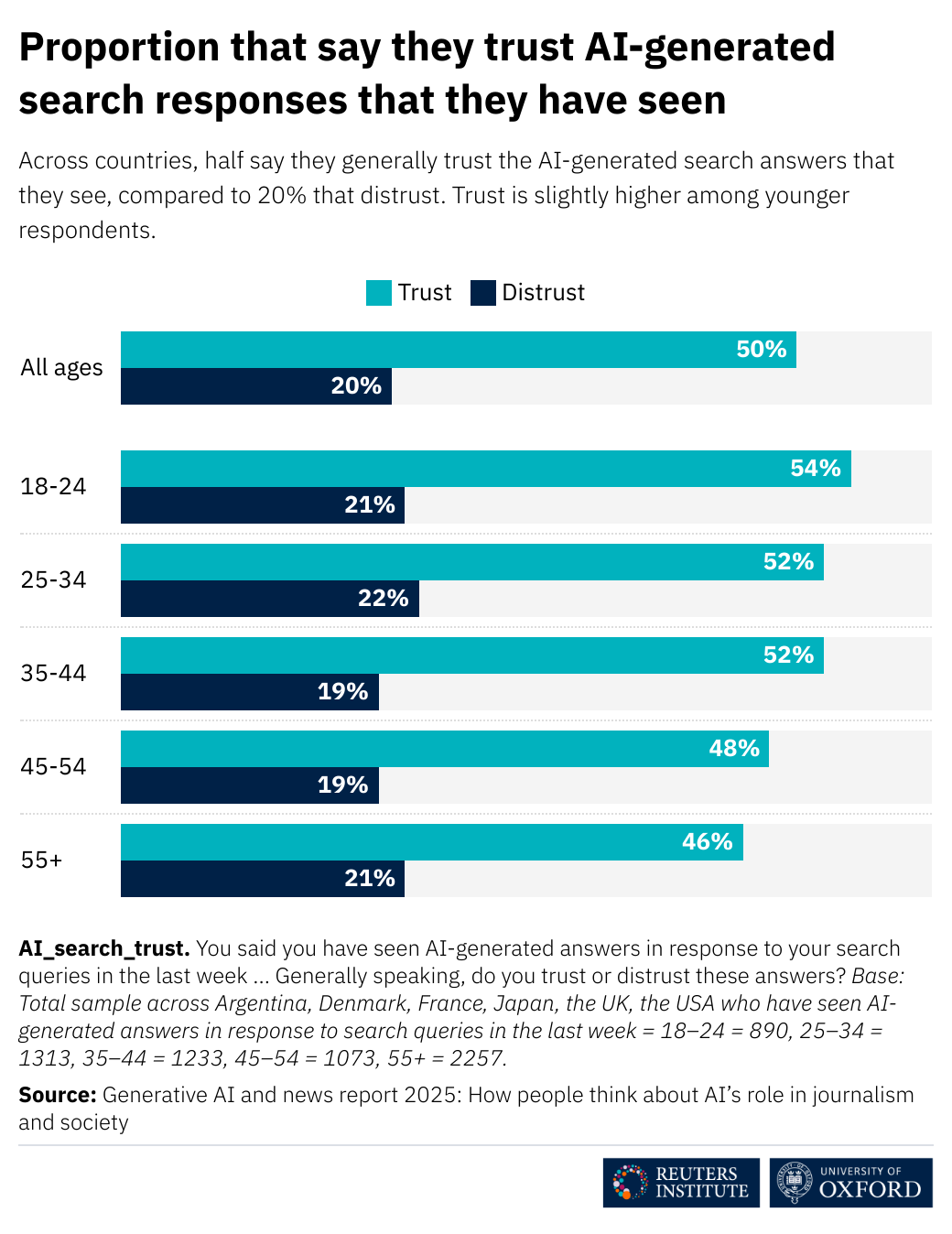
Finally, as search engines increasingly integrate AI generated answers, and more and more of us see these all the time, we asked about trust in these answers – the trust scores are high across the board, with higher net positives than any of the standalone tools. (With this and the question above, surveys do not measure whether the entities in question are trustworthy, and do not tell us anything about whether people should trust them, they provide data on whether they do trust them.)
Beyond that, the report, which I wrote with Felix Simon and Richard Fletcher, and which is published by the Reuters Institute for the Study of Journalism, is chock full of fresh data on generative AI use (basically doubled since last year), what people use these tools for (increasingly for information, presenting a very clear direct competition to search engines), and what they don’t (yet) use them for all that much (getting the latest news).
I was asked about alternatives to dependence on dominant US American for-profit platform companies at an Internet Governance Forum today. Below my response – for those interested in more from me on the topic, I spoke at somewhat greater length about it at the Nordic AI in Media Summit back in April. More broadly, everyone interested in this topic should read the Eurostack pitch paper.
There are plenty of options, but I think the real question is, we need to hold people in positions of power, including public and political power, to account in terms of how they understand the issue and whether they act accordingly.
The question here – when looking at dependence on US-American big commercial platform companies – is which part of that phrase you stress.
If you think the problem is that they’re US-American, then the path you pursue is obvious.
It is that you try to create national, or in the case of Europe, regional champions. And then when they have the right passport, and you are reliant on “grande technologie” rather than big tech, things are fine, right? Because then those companies are beholden to a different set of politicians. And then let’s just hope that whoever is the next inhabitant of the Élysée is not going to abuse that power the way that we see in some other cases. The question then question is whether we as [citizens] can expect very different behavior from large corporations who hold different passports. […]
Then the second way to think about the problem is that they are big.
Now then the alternatives are also, I think, quite clear. You’re thinking about decentralized, federated, open source solutions.
Now I think it needs to be very clear that very few people in positions of power seem to think this is the problem, because if they did, they would pursue those alternatives already, because they exist, like the Fediverse including Mastodon or LibreOffice. There are options in this space and we have now 25 years of revealed preference from people in positions of power. This is not what they want. So those alternatives exist, but they are not being pursued.
Then finally, of course, your analysis might be that the problem [with incumbent dominant platforms] is that they are commercial and that’s where we can turn to the possibility of public service alternatives.
And I think it’s possible to do this. It’s not easy. We need to decide what are they going to do? There are many layers of the stack one could look at. How are they going to be funded? This is not going to be cheap. Who’s going to make the rules and who’s going to enforce them? Like all the controversies we see around content moderation decisions. Imagine those only with the politicians in your country of origin making the decisions rather than Mark Zuckerberg and his Oversight Board.
The question then is a question of priorities, right? In Europe alone, we spend an estimated 40 billion euros a year on public service media. That has been stagnant, in some cases declining in recent years, but we could make investments of a similar size. Europe is a 20 trillion US dollar economy. Public spending in Europe alone is about 10 trillion euros a year. It’s a question of priorities.
And that’s why I think we really need to be clear about.
The full panel is available from the IGF on YouTube and was a great discussion with really interesting participants.
Speakers:
Kjersti Løken Stavrum, Chairman of the Board, CEO, Schibsted, Tinius
Anine Kierulf, Associate Professor, UiO and the Norwegian National Human Rights Institute
Rasmus Kleis Nielsen, Professor, Uni. Copenhagen, Reuters Inst. for the Study of Journalism
Chris Disspain, Former Vice-Chair of the Board of ICANN, Chairman of DNS Capital Ltd, author, lawyer
Anya Schiffrin, Director, Tech., Media and Comm., Columbia University
Tawfik Jelassi, Ass. Dir.-General/Deputy Dir.-General, UNESCO
Pamella Sittoni, Executive editor/Managing Editor, Daily Nation/Nation Media Group (prev)
Moderator:
Helle Sjøvaag, Prof. & Vice Dean, University of Stavanger
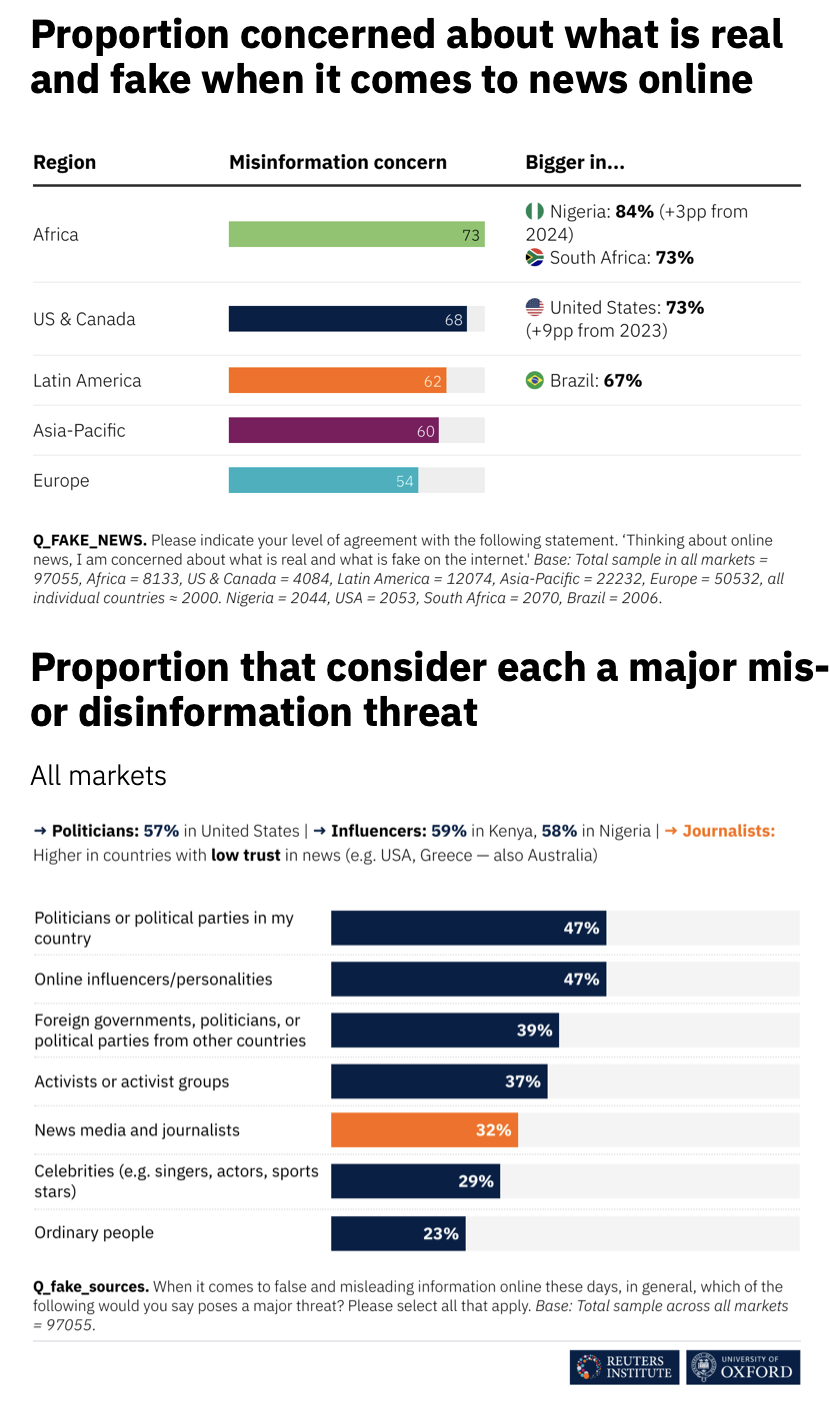
“Alternative media voices often have a wide reach and appeal to audiences that news publishers have been keen to engage with but the report also shows that, when it comes to underlying sources of false or misleading information, online influencers and personalities are seen as the biggest threat worldwide along with national politicians”, Mitali Mukherjee writes in her introduction to the 2025 Digital News Report.
There are countries where news media still have a strong connection with much of the public, and where publishers have adapted well to a challenging digital media environment (including my native Denmark), but overall the report is a sobering read for the news media. As lead author Nic Newman writes: “In most countries we find traditional news media struggling to connect with much of the public, with declining engagement, low trust, and stagnating digital subscriptions.”
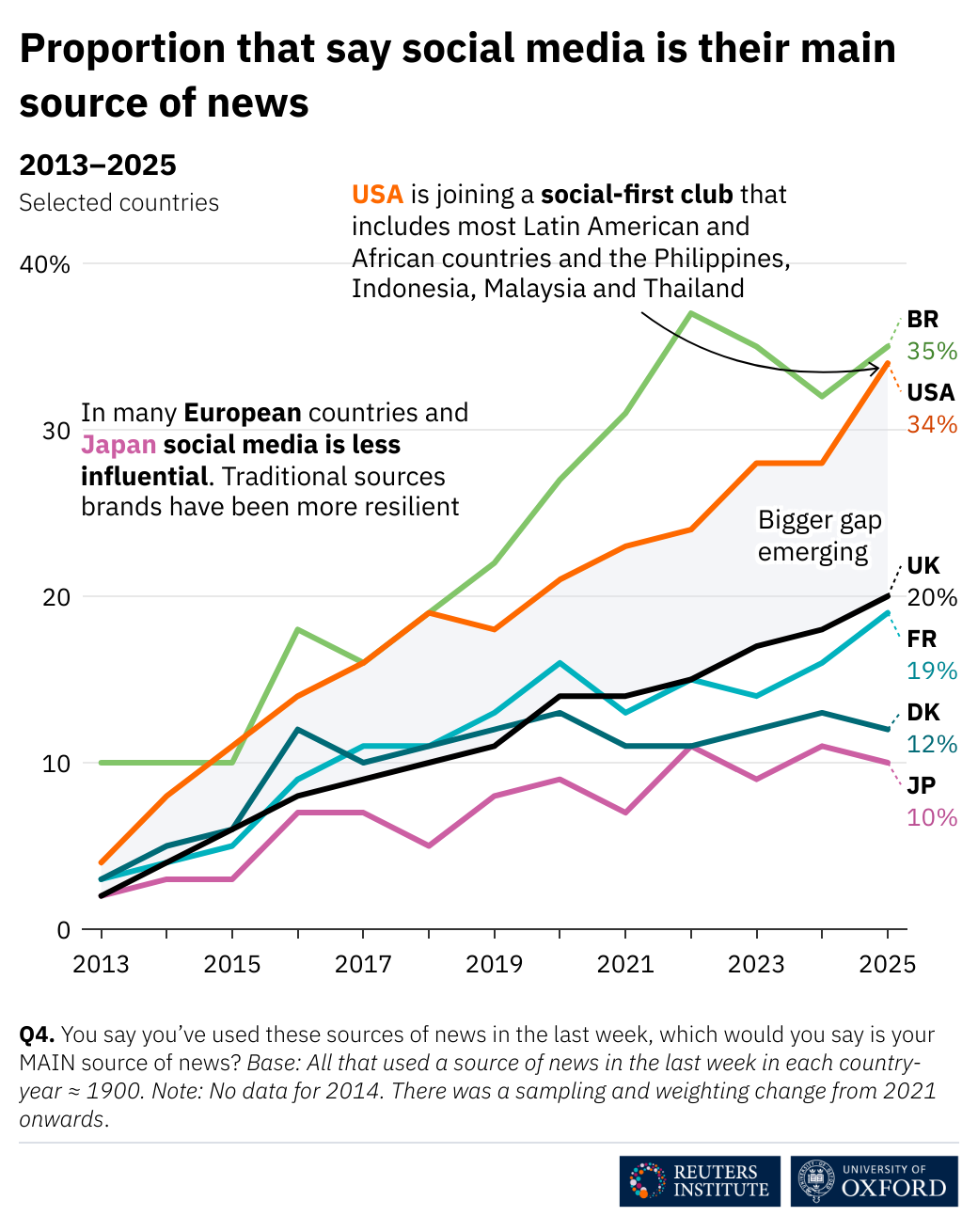
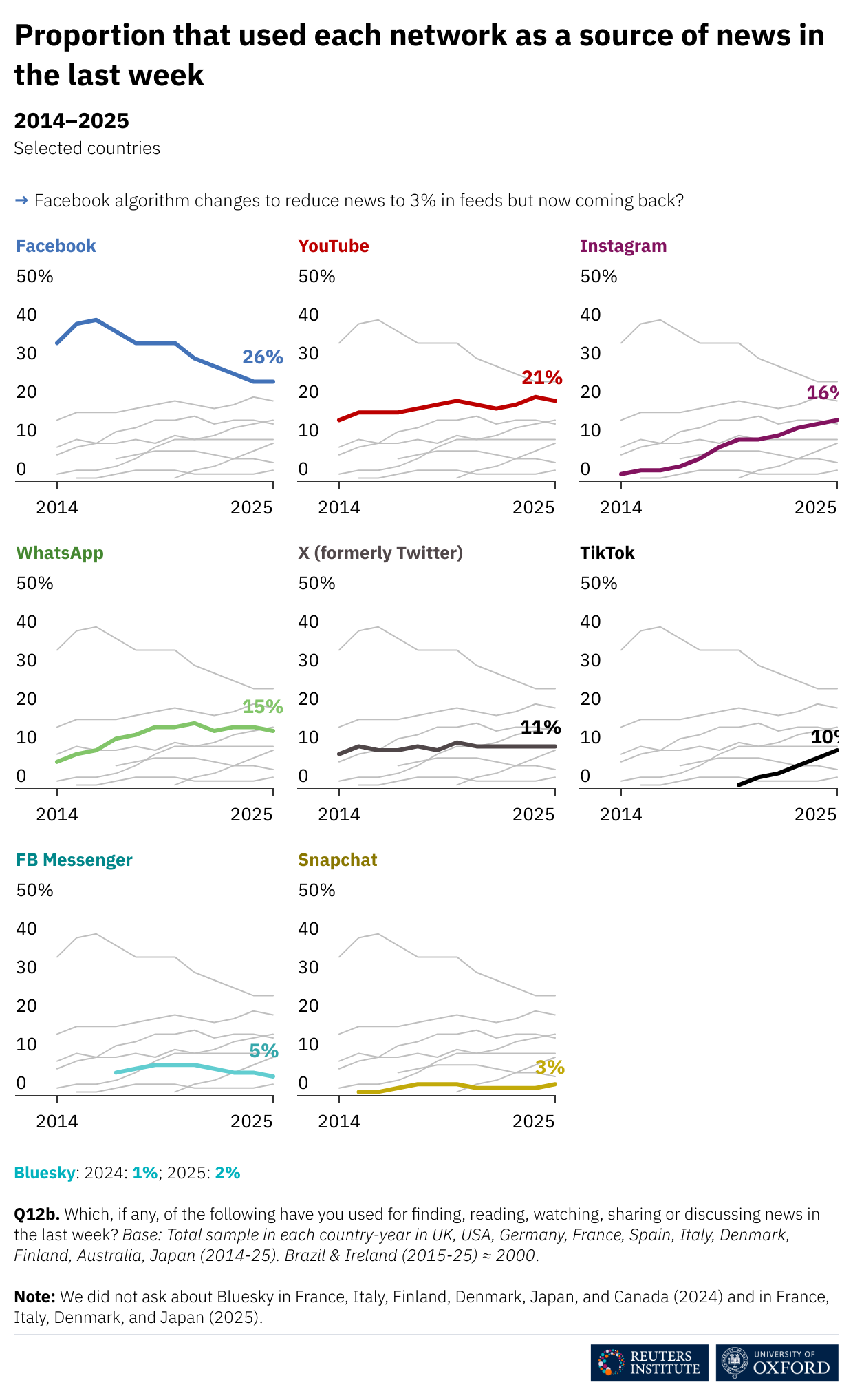
In the report, we document how platforms are increasingly central to how many find and access all sorts of content, including news, as well as a continued fragmentation of the platform space. There are now six networks with weekly news reach of 10% or more compared with just two a decade ago. Instagram, WhatApp, and TikTok in particular have grown in importance, whereas BlueSky still only has tiny reach amount our respondents.
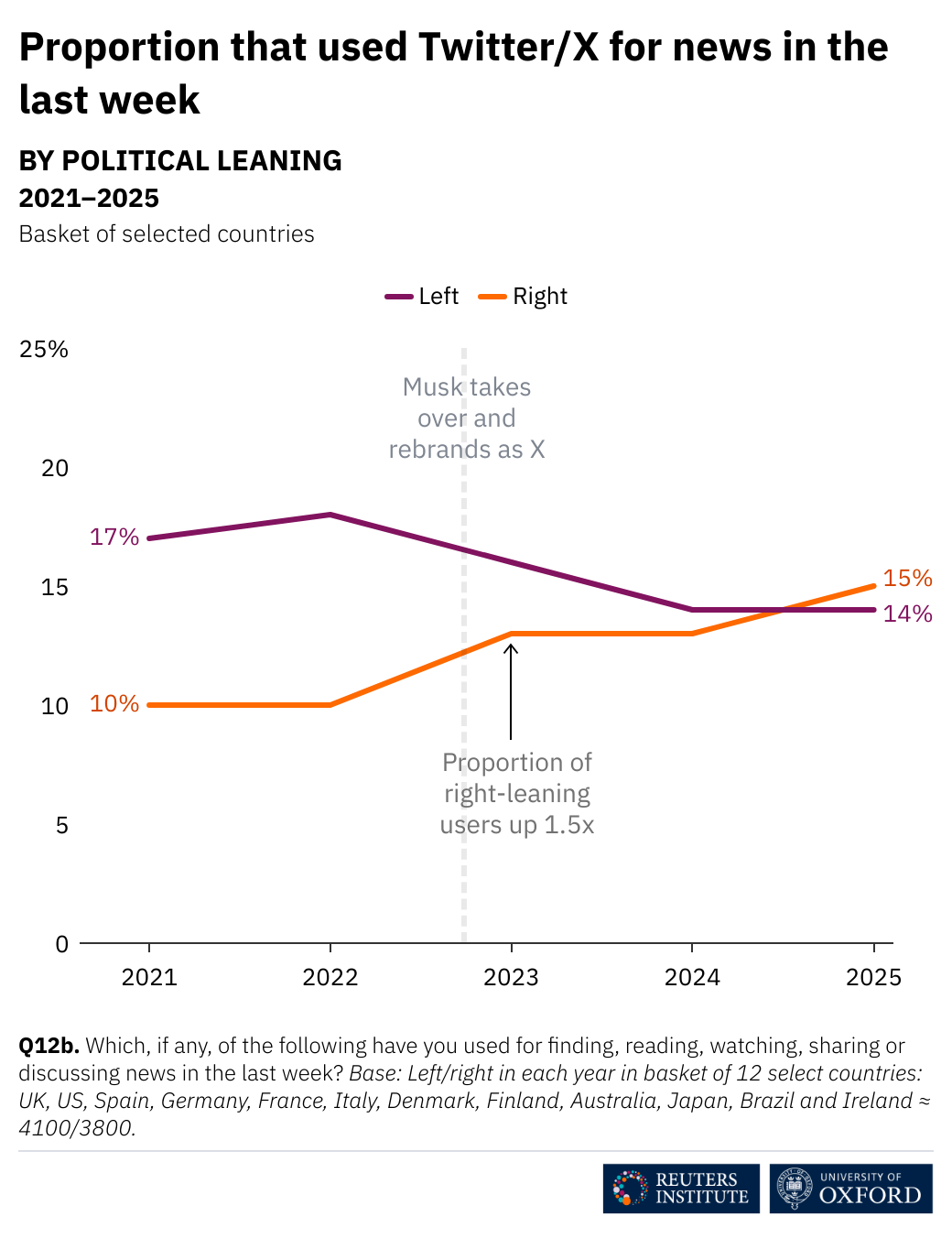
While industry data suggests X is much diminished in terms of how intensely it is used, survey data on weekly use – perhaps surprisingly – suggests stable reach overall. A liberal exodus seems to have been matched by a growing number of right-wing users, and after many years of having a predominantly left-wing user base, X now has slightly more right-wing users.
In this increasingly distributed and platform-dominated environment, large parts of the public continue to be concerned about what is real and what is fake when it comes to online news – when asked what they are most concerned about, domestic politicians and online influencers/personalities top the list, in terms of platforms, concern is focused on Facebook and TikTok.
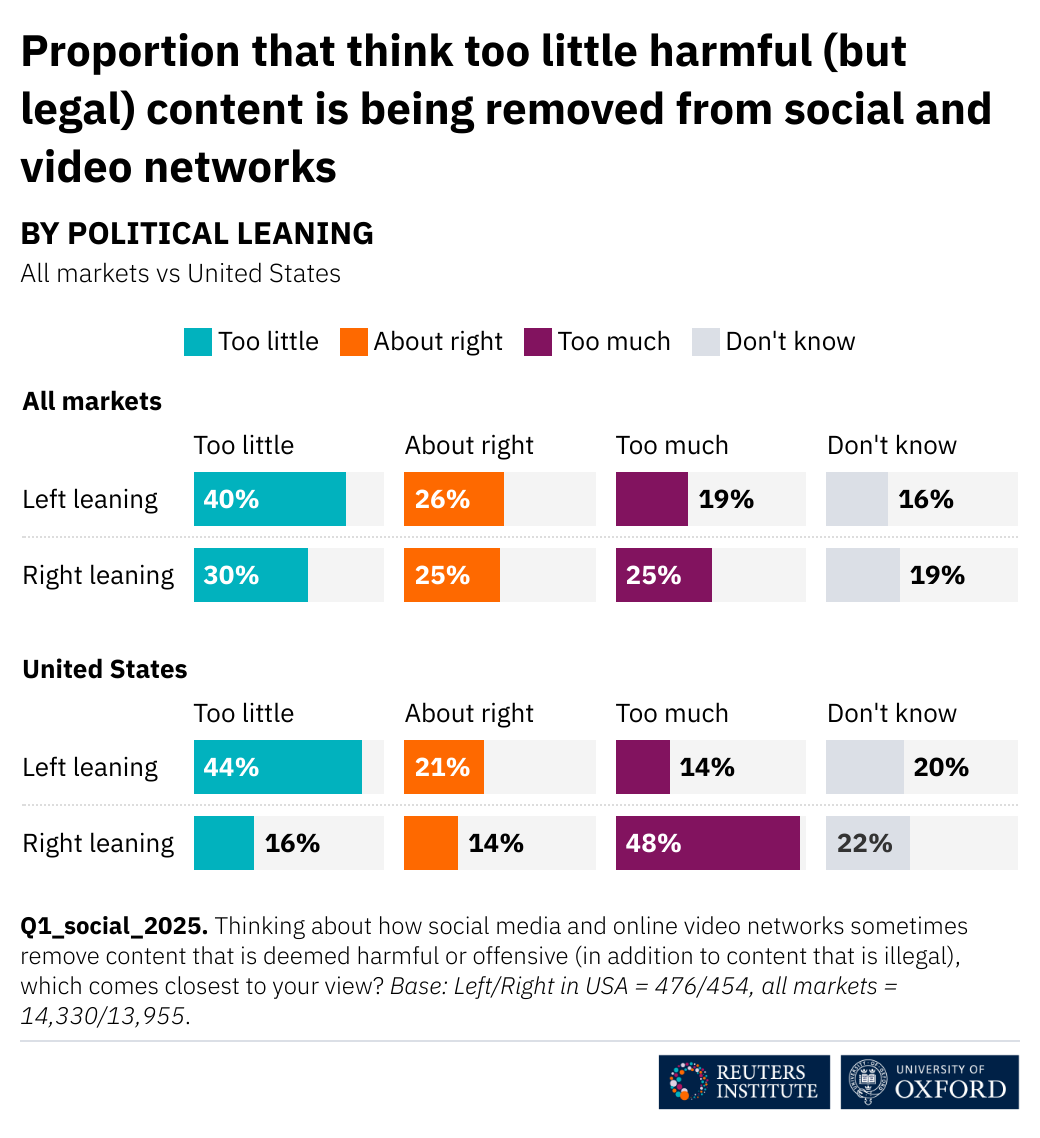
First Elon Musk and later Mark Zuckerberg has said they want to reduce how much content is subject to moderation on their platforms – while some political actors may applaud this, it is not clear the public does. A plurality in many countries say they want more harmful or offensive content removed from social media.
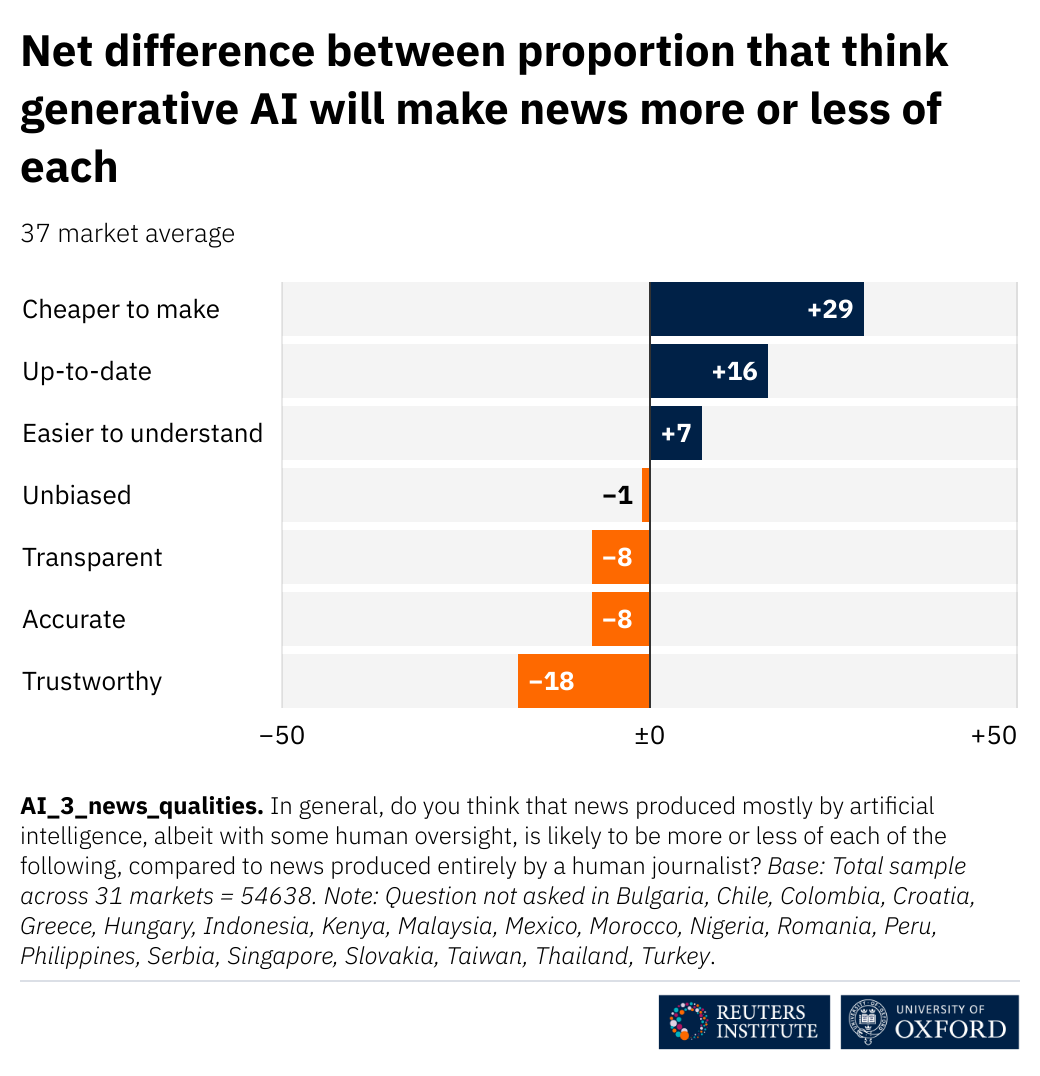
Finally, as generative AI is increasingly widely used, integrated into platforms, and adopted by many news publishers, we asked respondents what they think this will mean for news content – while there is some optimism AI-powered news will be more up to date and easier to understand, the topline is people expect it to be cheaper to make but less trustworthy.
All that and more in the 2025 Digital News Report, with topical chapters, country pages, interactive data, and more on the Reuters Institute website – an incredible team effort that I am proud to be part of.
I gave the closing keynote at the 2025 Nordic AI in Media Summit April 24 under the title “What could ‘European alternatives’ mean? Three possible platform models in search of your support”.
Photo credit: Philip Jørgensen
As a scientist, I prefer to deal in reliably, empirical knowledge, but I was grateful to be invited to think aloud in terms of possible responses to the current moment in geopolitics and tech.
If you are interested in my three possible models, each of which represent an approach trying to solve for a different definition of the problem ( (1) reliance on American tech? Airbus-for-the-internet as national/European champions!, (2) reliance on for-profit tech companies? BDC/public service platforms! (3) reliance on big technology companies? Mastodon as a decentralized, open-source alternative!).
In each case, for every alternative, at every level of the stack, at least three questions need clear answers – what, exactly, is the alternative meant to do, who will fund it, and how is it going to be governed.
It all strikes me as a wicked problem akin to climate, defense, and the future of strained welfare systems – and of a comparable scale and scope, and seriousness that requires serious responses. I hope the models I outline and the questions I offer can help structure how we discuss possible responses and move beyond the declarations and rhetoric that suffice for headlines and a bit of publicity, but don’t actually change anything.
Wrapping up the year grateful for how people have engaged with “Avoiding the News”, the book Ben Toff, Ruthie Palmer, and I published at the beginning of the year. Sharing it with the world has, as we hoped it would be, been the beginning of a wider conversation, not the final word.
In the book, we draw on hundreds of interviews as well as survey data to show that news avoidance is not “just” a response to the content on offer in the news. but also fundamentally shaped by who we are, what we believe, and the tools we rely on. It happens at the intersection between identity, ideology, and infrastructures, and tends to compound existing inequalities.
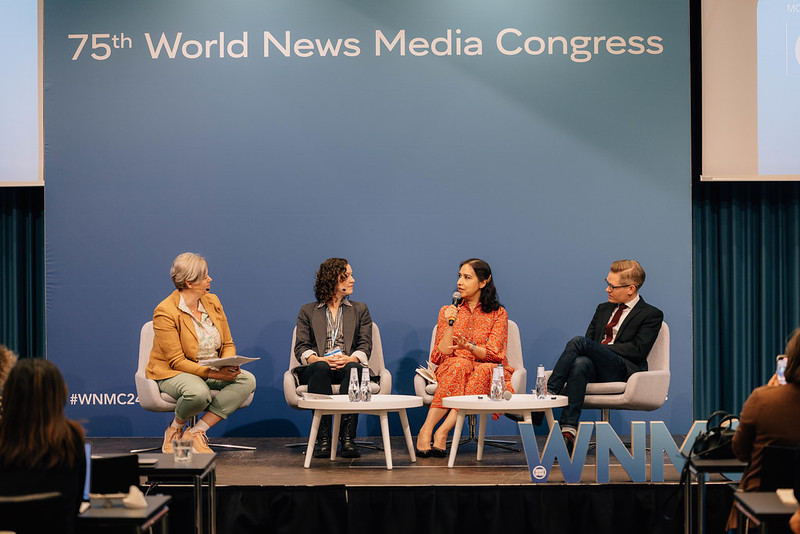
Ruthie Palmer and I on stage at the World News Media Congress, discussing the book with Amalie Kestler and Shazia Majid.
We have had numerous conversations with journalists and editors concerned about the fraying connection between much of the news and much of the public, a chance to discuss the book with participants at the International Journalism Festival, with experienced journalists and editors at the World News Media Congress, and seen reporters from the New York Times, the Washington Post, and elsewhere engage with the work. There also continues to be a vibrant community of academics researching the phenomenon in various ways, some of them contributing to a special issue of Journalism Studies on the topic.
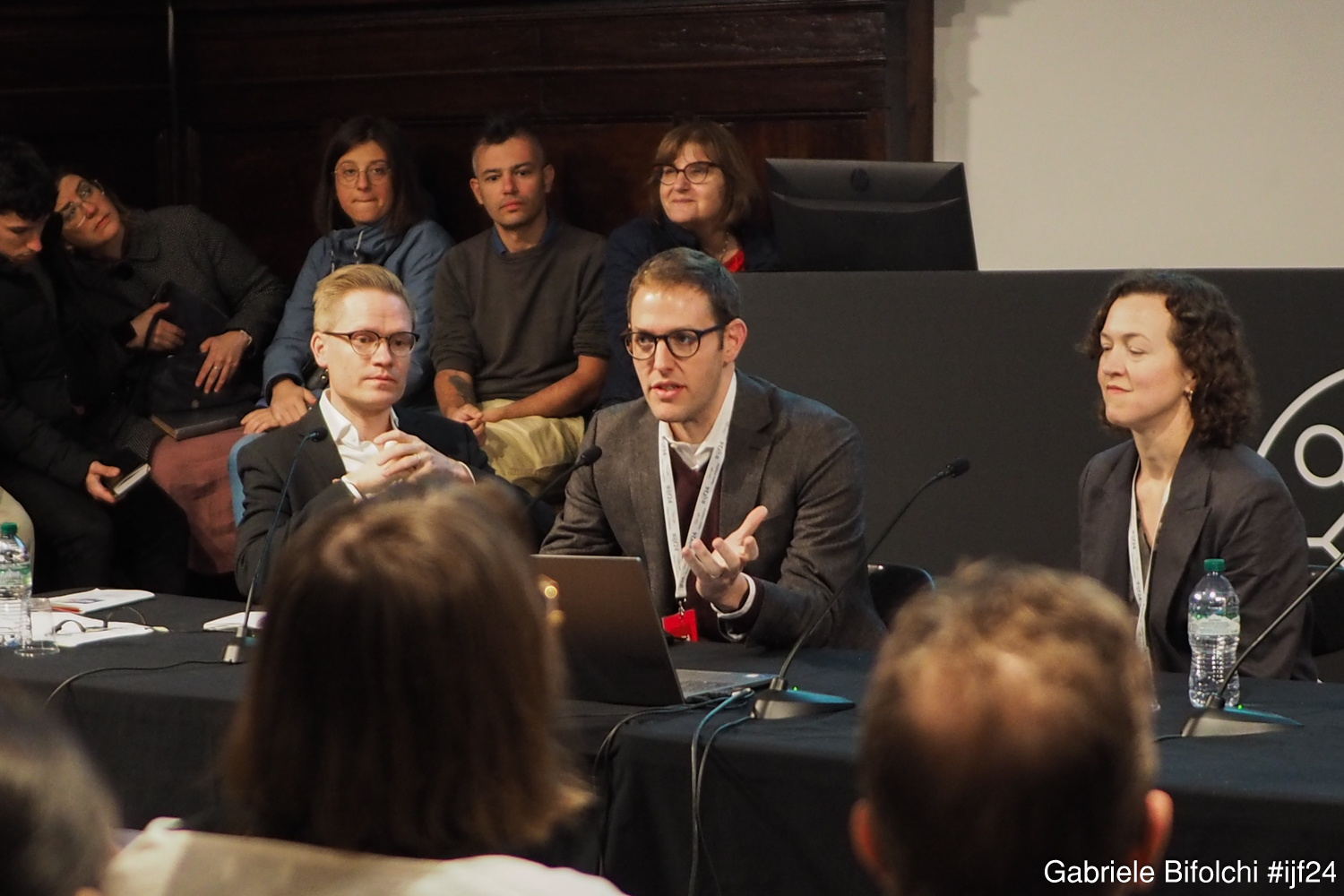
Ben Toff presenting during our panel session at the International Journalism Festival.
The book has also been named a Choice Outstanding Academic Title, an award given by the American Library Association’s Choice Reviews to “outstanding works for their excellence in presentation and scholarship, the significance of their contribution to the field, their originality and value as an essential treatment of their subject”.
We hope journalists and those who care about journalism will continue to engage with the analysis we present and the issues we identify.
If you are curious about the book, you can read an excerpt here where we identify the groups more likely to be consistent news avoiders, if you are interested in our thoughts on how journalists could respond, we discuss some options here.
The book is available here from the publisher, Columbia University Press, with a 20% discount using the code CUP20SM.
* The problem is not the public – people are interested in the world around them, they use media to explore it, make sense of it, and navigate it, and engage with content and information they find useful and relevant.
* Transitions are hard for news media, but also demonstrably possible – leaders from a range of very, very different kinds of publishers were very clear they think believe much of the current industry is at best in managed decline, but also that they see a range of sustainable paths forward for the business of news.
* Part of that is the useful discipline of having to reach your audience – several participants spoke in different ways about how the shift from direct discovery through channels dominated by news publishers to distributed discovery through platforms while in many ways very challenging has also forced a new, healthy, humility on journalism and the news media by making clear they can never take the public and people’s attention for granted.
All contributions are confidential but under the Ditchley rules we can draw on the substance of it as long as we do not disclose who said what – I was glad that this year’s discussions were much more respectful of the public and more cautiously optimistic about the future of (parts of) the news industry than many such discussions I have been part of over the years.
I am very grateful that the Danish National Science Foundation has awarded me a DNRF Chair grant to support my new project “Power over Platforms?”.
Power over platforms?
The aim of this 3-year project is to understand how power is exercised over platform companies such as Google, Meta, and their competitors by actors who have neither raw economic nor formal regulatory or legislative means.
The focus is on how civil society groups, interest groups, professional associations, and companies from other sectors sometimes actively try to shape how platform companies operate. The starting hypotheses are that these actors (a) do this because they believe they are able to exercise at least some influence and (b) this is sometimes the case.
Systematically analyzing the actors involved in trying to influence key decisions made by different platforms on key issues—content moderation, privacy, and the use of generative AI for political information and speech—across different jurisdictions (the US and UK as major markets outside the EU, key markets inside the EU), and across different platforms (primarily consumer-facing content platforms including Google, Meta, and their smaller competitors TikTok, X, Snapchat, and Reddit) the project sets out to identify who seeks to influence platform governance, how, and what the outcomes are across countries and across companies.
The project builds on and goes beyond previous work on the “Power of Platforms” I did with Sarah Anne Ganter, and seeks to expand our scientific understanding of platform governance by analyzing a wide range of actors involved, some of whom have received limited attention from researchers. It aims to provide insights which can in turn help inform public and policy discussions about how to respond to the role that platform companies play in a range of important areas including free speech (through content moderation), privacy (data protection and encryption), and, with rapid development and deployment of generative artificial intelligence, new ways for people to exercise their fundamental right to receive and impart information and ideas.
This is an important area to research because platform companies increasingly develop and enforce principles, policies, and practices that go above and beyond what is legally required in defining what they consider acceptable behavior and content. But who, in turn, seeks to and sometimes manages to influence how the companies do this? When do they succeed? These questions are at the heart of the project.
I will be working with two postdoctoral researchers on the project (interested in these posts? Details here – apply by December 13) and various international collaborators.
I’m going to tell you a story about what’s happening to journalism and news media across the world. There are a lot of variations, differences between countries and organizations and communities being served. But I still think there are some big themes that we can recognize that are worth going out to recognize where we come from, where we are, and where we might go in the future.
Where we come from
So if we start with where we come from, journalism has a lot to be proud of. At its best, it’s an occupation that is committed to seeking truth and reporting. it. It provides a way of telling people stories that can make them understand other people’s experiences, but also sometimes their own experiences in a new light. It can portray the contending forces in the world so that people can relate to some of the titanic forces at play beyond our own immediate circles.
And at its best, it both aims and sometimes is in fact able to help people understand the world beyond personal experience and make the invisible world visible in a way that is profoundly empowering.
One of the reasons I do what I do is that I’ve seen so powerfully in my own family of people who in the past had little access to formal education and few of the structural privileges that we associate with bourgeois citizenship, how profoundly important journalism was in enabling them to connect with the world beyond personal experience and be active participants and shape and reshape that society in line with their own ideals and their own interests.
And there is something special about journalism that’s not unique in trying to help individuals be citizens, but often would aspire to do so in a way that is independent of the powers who actively try to reshape society in particular directions.
Whether you think of that independence in terms of an ambition to be impartial, or whether you think of that independence as being upfront and clear about your point of view or your editorial line, what those different conceptions have in common, I think, is at least a commitment to not do it on behalf of some other organized interest or force in society. This is how journalism can retain its autonomy of the many other forces at play.
This wild and varied set of aspirations gives us a way of thinking about what many journalists would like to achieve. It also gives us yardsticks by which we might judge ourselves when we fall short. Nothing is perfect, and the history of journalism is certainly not perfect either.
I think it’s also important to recognize that these are things that much of the public would like to have from journalism.
This is one of the most powerful themes in years of research that we have done at the Reuters Institute on people’s relationship with the news – much of the public has what might come across as surprisingly conventional, or in a nicer term, classical, expectations of what they would like to have from journalism.
They would like journalism to provide a way to stay up to date with what’s going on in society. They would like journalism to help them understand things that they are not themselves familiar with. They would like journalism to convey the range of different perspectives on some of the issues that we face as societies. These are aspirations that journalists have, and they are things that much of the public would like to have from journalism.
And over the years, of course, professional practice and the occupation of journalism grew up in part in pursuit of these aspirations, and in part grew up inside of media organizations and businesses that made money off of investing in this professional practice. At the dawn of the century in Berlin alone, there were well over a hundred different newspapers.
This is a very different world from the one we live in today. If we move from the profession to the business that employed these journalists, and that many of these journalists were themselves active in – we have to remember that many of the pioneers of journalism, the great reporters and editors of the 19th century and early 20th century were entrepreneurs. They were interested, yes, in the editorial side. But they were also interested in the business side that enabled editorial autonomy from the state, from political parties, from organized interests, and from other businesses.
The environment in which they thrived was an environment that, from the point of view of people such as my family – members of the public – was one where citizens had a low choice media environment, not that many ways in which they could access information about the world beyond personal experience.
As a consequence of that, those who controlled the printing presses had high market power, high market power over the public and high market power over advertisers. And this in turn produced a, in many countries, very lucrative business. Profit margins in the double digits and a sort of a veneer of stability and success that we associated with newspaper companies in particular, till relatively recently.
It is also, I think, obvious to everyone in the room that this is not the world we live in anymore. And it hasn’t been for quite a long time. But I think it’s important to start with that world because it’s so profoundly still shaped the profession of journalism and the media organizations that employ journalists. Many of them are still at least in part oriented towards the world of yesterday even as they have to navigate the world of today and tomorrow.
Where we are
So what is the world in which we live today? I mean in the simplest sense you might start with the relationship between the public and journalism and just recognize that if the world of my grandparents and parents was a world of low choice for the public, high market power for publishers, the world of today is a world of high choice for the public and low market power for publishers.
This means that the business of news is far less lucrative than it was in the past and it means that the unearned confidence that journalism had in a world in which, essentially, journalists wrote and people like my family read, has been blown out of the water because now everyone can raise their voice and many of them do that – including very critically and in ways that contend and sometimes outright attack or harass journalists.
We need to be very, very clear about where journalism sits in this fundamentally transformed media environment.
Because it is not the case that people have turned their back on the ways in which media can help you imagine a richer and more varied life than what you live yourself. In fact, people spend more time and in many cases more money on media than they did in the past.
What is the case is that the role of journalism in this more varied and from the point of view of much of the public, frankly richer and better media environment has shrunk.
We really need to be clear-eyed that every day the public is voting with its attention and with its wallet, and they are not voting for conventional forms of journalism.
The shift from the old world to the new world is not about people not having access to printed newspapers or linear scheduled broadcast channels or linear scheduled radio channels.
It is about them not choosing them when they have found things they find more satisfying and rewarding and valuable to them.
This shift has been incredibly disruptive for the business of news that journalists were employed by, even as a profession sort of drifted away from seeking to assume responsibility for the business that made journalism possible.
And the shift is actually even more challenging than just the financial crisis. Because there’s also a loss of cultural prominence in our societies that we can see in so many ways in audience research.
Every day the public is telling us things and it is up to us what we make of them and whether we want to convince them to see the world differently or whether we want to respond to what they’re telling us.
What are they telling us even as the old business of news is busy dying? Well, we see expressed levels of interest in news is in decline in much of the world. That trust in news is in decline in much of the world. That levels of active news avoidance is on the rise in many parts of the world.
And essentially, if I want to be really pointed about it, a significant and even growing part of the public, particularly younger people, people with lower levels of income, lower levels of formal education, historically poorly served minorities, in many cases women as well, are expressing in our more qualitative research – interviews, focus groups and the like – that they find that journalism irrelevant, depressing, and incomprehensible.
The public is essentially telling us every day and in growing numbers that even though they often want what journalism aspires to provide, they’re not feeling that we’re delivering it in a way that makes it worth their while to engage with us.
Think about what this means – there is a lot of concern in the industry about how can we convince people to pay for news. As a sort of a way of overcoming some of the business challenges that are consequences of these great structural transformations that I have very briefly outlined.
But in a sense, the problem is much more fundamental than convincing people to pay. The problem is that publishers are struggling to convince people to pay attention to news. And that, I would say, logically is a precondition of them before they would want to pay.
This is very clearly a crisis. It’s a crisis for the organizations that employ journalists, yes, that is a concern for their shareholders and owners. But it is also a concern for the profession of journalism, people being laid off, and many companies are really struggling to find better ways forward than just managing decline.
And it is a very real crisis for the profession, as I said, in a more profound cultural sense, of this fraying sense of public connection.
The idea that much of the public does not see journalism as providing the public value that journalism would say it is premised on providing. We may disagree with that judgment. Then there is a persuasion challenge. We may also feel that sometimes people have a sense of what they want, what they need. In those cases, I think we have a product problem.
Because we need to recognize, again, that it is a crisis for journalism and a crisis for the news industry but it’s not at all obvious that it is a crisis from the point of view of the public.
This year in the annual Reuters Institute Digital News Report when we surveyed people in 47 markets across the world, amongst the many questions we ask people was how well they felt that their different information needs were being met. You might think in a world in which many of those of us who care about journalism and the news industry increasingly are talking about news deserts and crisis of provision of factual information and the like – all of which are very real phenomena and very concerning phenomena – that the public at large would think about these challenges in similar terms.
But this is not at all the case.
The vast majority of our respondents would say on everything we asked them about that all or most of the information they needed was available to them, irrespectively of whether they paid for news or not. To them, irrespective of whether they paid for news or not. So we don’t know what we don’t know, and sometimes we have needs that we are not aware of, or informational things we would benefit from if they were available to us, even though they are not. But I think we really need to be very clear-eyed, that from the point of view of much of the public, what is happening to journals and the news is not a crisis for them – it is a crisis for us.
Where we might go in the future
That recognition is also where the work to address the crisis needs to begin, and this is where I think we need to turn from the past and the present towards the future and where I think it’s so important to recognize just the enormity of the forces that the people who will join me on the panel have found ways to navigate.
To be slightly reductionist about it, we can stylistically suggest that there are two main ways in which the industry has reacted to this structural transformation. There is what i think of as a rearguard reaction which is essentially is the view that things worked great and the problem is that the world has changed. Then there is a different view which is more of a sort of vanguard approach, which is that essentially the view that whatever things were like in the past, the problem now is that things have changed and we haven’t.
I’m not going to dwell here on whether things really were great in the past, other than just say, that even in what in sometimes in retrospect is seen as the high point of high modern journalism, a period that may look like a golden age from the point of view of those who worked in it and those who owned and ran the companies that dominated it, I think we need to be very clear that many people were very poorly served by that kind of journalism. And that the biggest difference perhaps was that they lived in a world in which most people couldn’t really find alternative sources or raise their voices in public, and now they can. But of course, it also had incredible value, and something very real is being lost as those institutions and those professional practices unravel.
So where do we go from there? I mean, if you think of these two stylized responses, I want to be clear that this is not meant to in some absolute sense judge this. Rearguard action works for some people and some communities and there is real value in the kinds of journalism that are being done and there are still declining but real business built around providing it. So it is sensible from the point of view of those people who do that work those businesses serve those audiences and those shrinking aging and ultimately dying audiences to continue with defending what, crudely put, works for me and older versions of me, what works for the highly educated, affluent, urban, engaged, willing to pay, middle-aged or older, and often in many societies, white men.
But it doesn’t work for everybody and it doesn’t work for them in the future.
With exception of a few winners in a winner-takes-most market consolidation, this form of journalism, this business, is in inexorable one-way decline. And it doesn’t work for many of the parts of the public that are most poorly served by this existing professional practice and business.
It doesn’t work for younger audiences. It doesn’t work for precisely the kinds of people that, as I said, I’ve seen in my own family history, have benefited so much from journalism in the past. People with low levels of formal education, lower levels of income and life, for whom journalism made, in a sense, the biggest difference at its best. It doesn’t work for those parts of the public, and it doesn’t work for historically underserved communities.
What these parts of the public say they want is not something that is not journalism.
As I’ve said at the outset, our research documents again and again that much of what people say they want from journalism is very well aligned with very timeless professional aspirations to seek truth and report it to provide analysis and understanding and arrange different perspectives. The problem is not that people are not interested in these things. It is that a large part of the public does not feel that we are providing it.
So what does one do then in response? I think what some of the most impressive pioneers have done whether they work in legacy titles or in startups is that they have returned to some of the thinking of the origin of the profession, but flipped it around.
So instead of thinking about what we did then, they’ve been thinking about who we did it for. They have put the public at the center of how they think about journalism and the business of news as a form of value creation.
They recognize very clearly that journalism exists in the context of its audience, that the political importance, the social significance, but also the economic sustainability of journalism as a professional practice is premised on the relationship with the public that it serves. If we lose sight of that and ignore what people are telling us, or only super serve the ones we are currently serving really well, then it is not surprising that we are losing touch with much of the public and struggling to make our businesses work. And I think that really is where we are seeing some of the most impressive and innovative work again across sometimes legacy titles and also new startups.
I want to be slightly rude here, if i may, and say that, with the greatest respect to my U.S American friends and that great citizen republic across the ocean – I don’t think the most interesting things right now are happening in the United States of America, because I think the rearguard action there takes the form of a few super successful companies over-serving people like me and then managed decline of asset-stripped companies in much of the rest of the industry. And then really, really interesting non-profit support and initiatives, yes – but initiatives that are so closely intertwined with the unique foundation and philanthropic funding environment of the United States that really does not exist anywhere else in the world. So I really think that people elsewhere should cheer on the US Americans for what they’re doing, but not always look there for inspiration.
I think far more promising and interesting things are happening across Europe, in really difficult markets – Dennik N in Slovakia, 444 in Hungary – as well as in more privileged markets. Lea is here from Zetland in Denmark, we have colleagues from Republic in Switzerland, and we see others like MediaPart in France or El Diario in Spain.
We’re seeing really impressive things. And I think there are some commonalities, and this is where we should really hear from the people who are doing the hard work, not those of us who are sort of admiring them at a distance as we analyze what’s going on.
But I think that some of the things that are happening are really about putting the public at the center of what journalism is and what the business of news is.
It’s about connecting with people. It’s about meeting them where they are in terms of their preferences for platforms, but also culturally. It’s about centering their needs and interests rather than this rather imperial “we-publish-your-read” attitude, this “we will tell people what they need to know” attitude that I think was quite widespread in the past and I think that that is where we will find the foundations from which we can build the journalism of tomorrow, a journalism that is better than the journalism that we had yesterday.
What will that look like? I don’t know!
I don’t think anyone know.
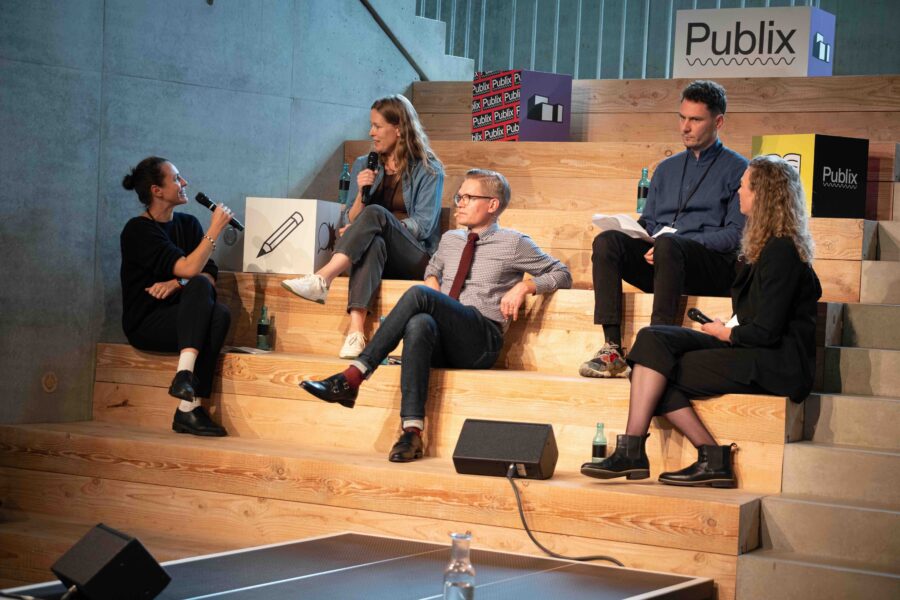
This is where Publix and you all fit into this.
I think the only way in which we can find out all the ways in which that could look is if we try looking for it, and if we wrest ourselves away from this picture that has held us captive of what journalism was and start thinking about what it might be. And I think that’s the invitation of Publix as a house and i think that is where the people who join me on stage now provide ideas, examples, inspirations that may not work for everyone or every community, but work for them and are different from what come before.
So with that, I look forward to the panellists joining me and to the conversation we can all have.
Thank you very much.
(Lightly edited transcript of my talk at the Publix opening conference September 12 2024 in Berlin, with links added to some of the underlying research. Picture by the organizers, with fellow panellists Maria Exner (Publix), Simon Jacoby (tsüri.ch), Lea Korsgaard (Zetland) and Katharina Binder (Media Forward Fund).)







 rasmuskleisnielsen.net